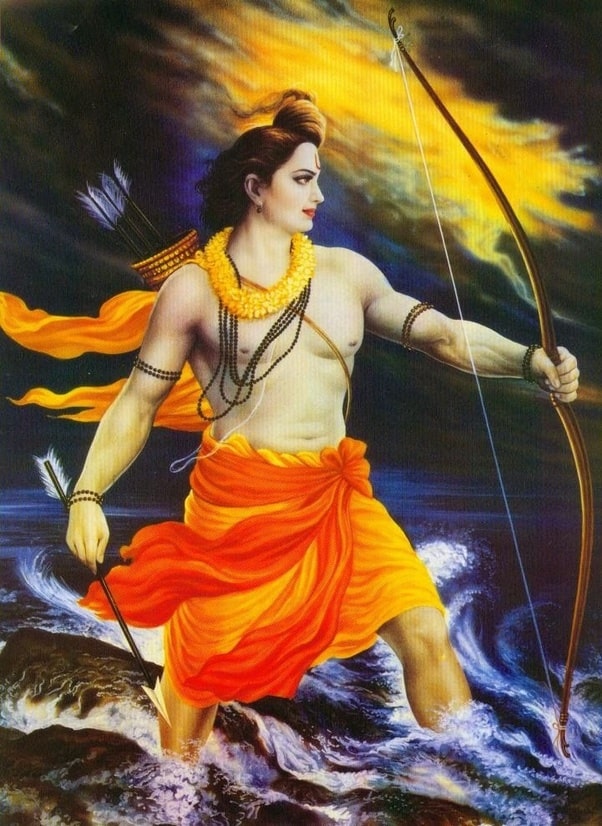
Lord Rama is the 7th Avatara (incarnation) of Lord Vishnu, who is one of the principle dieties (trimurtis) in Hinduism.
यदा यदा हि धर्मस्य ग्लानिर्भवति भारत।
अभ्युत्थानमधर्मस्य तदात्मानं सृजाम्यहम् ॥
परित्राणाय साधूनां विनाशाय च दुष्कृताम् ।
धर्मसंस्थापनार्थाय सम्भवामि युगे युगे ॥
It is said that as and when there is destruction of rightful conduct, as and when wrongful deeds are done, Lord Vishnu takes incarnation in order to restore the peace and order in the world.
Lord Rama’s incarnation happened in the Treta Yuga, the 2nd of the Four Yugas preceding the Dwapara Yuga and Succeeding the Satya Yuga.
Valmiki continued his penance and good deeds in a small ashram in the forest. One day he questioned the Sage Narada on the existence of the most virtuous, learned, compassionate, beautiful, humble, free from anger, respectful, honest and follower of dharma. It was on the insight he received from the sage that Valmiki composed the great epic in the form of Kavya (poetry) with Sri Rama in the lead role. The epic is not just the story of Sriman Narayana’s avatar, but also holds the substance of Vedas, Upanishads and Shastras, which is why the story of Sri Rama is called Srimad Ramayana. Born into the Ikshvaku race, the son of King Dasaratha, “Rama” beholds a very special place in the hearts of his devotees. His avatar is an amalgamation of numerous aspects of one’s life.
“Right from showing obedience towards a father, respecting a step mother’s decision, vanquishing demons for a teacher/guru, being a gentle lover and husband to a wife, protecting the life of a brother, paying a visit to his great devotee Sabari, fulfilling Jatayu’s desire to die on his lap, liberating demons and cursed maidens, becoming friends with Sugreeva, killing Vaali to keep up a promise, being affectionate and caring about his foremost devotee Hanuman, defeating Ravana and liberating him from his earthly form, to finally bringing back peace and harmony, the character Rama is brilliantly etched by the “Adi Kavi Valmiki”.
The avatar of Sri Rama was Sriman Narayana’s fantastic portrayal of becoming a complete human and never showing himself as an avatar. There were many chances for him to portray himself as an avatar with enough powers to destroy the evil and restore honour, but “Rama” never chose that path. He accomplished it all step by step. The Ramayana is a master piece in the literary composition and it is enriched with life lessons on human actions, reactions and motives which are applicable for all times in life. Not only do we see the many Ravanas in day to day life, be it in political field or economic power or even in the humblest families, we also see many “Ramas” striving to establish a balance in the system.

