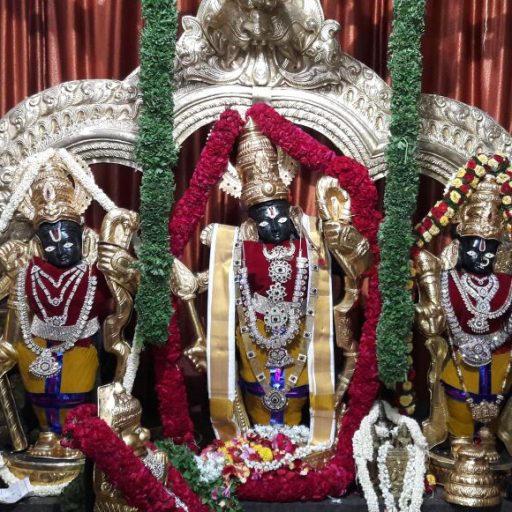
Sri Rama Seva Mandali
Sri Rama Mandira is one of the renowned temples situated in Rajajinagar, a prestigious area located in the Garden City of Bangalore. In 1956, this new extension was formed by the Bangalore Development Authority and was named as Rajajinagar, in the memory of His Excellency, Late. Sri Rajagopalachari Chakravarthy, the 2nd Governor General of India, informally called “Rajaji” who was an Indian Politician, Independence activist, lawyer, historian and statesman.
Later, Karnataka Housing Board built houses and according to rule, dispensed the built houses to the Government Employees, labourers and others which lead to development of the extension. In a short span of time, the extension was developed with more residential houses which resulted in increased population and in the meanwhile as per their needs, the transportation facility was also provided by the Government.
At this time, the people in this extension having a spiritual notion, decided to construct a temple. In the beginning, the devotees started “Bhajans” programme at home by keeping a photo of Lord Sri Rama and they started singing bhajans every week in each one of the members house. Later on, in order to start “Bhajana Mandira”, they formed an association with 12 members and Management Committee and named it as “Sri Rama Seva Mandali” and registered it under the Registrar of Societies Act, on 25/01/1956.
Due to insufficient space for organizing/celebrating any programme, the Committee decided to purchase a plot to build the temple and under the leadership of Sri. Kumaran, the then President of Sri Rama Seva Mandali, in the year 1958-59, submitted an appeal before the President of Urban Development Committee, Sri. Deena Dayal Naidu and with the grace of Lord Sri Rama, with the help of His Excellency, Sri Sriramulu, the Member, Sri Narayana Iyengar, Secretary and Sri. D.Krishna Swamy of Urban Development Committee and other members of Sri Rama Seva Mandali and succeeded in granting of a plot @ Rs.12/- rent p.a. After that they built “Bhajana Mandira” by collecting donations.
After sometime, in the year 1965, under the leadership of Sri V S Jayacharya, President, of Sri Rama Seva Mandali and with the consent of all the members, it was decided to build a temple and the said work started on 22/03/1965. The construction was completed on 27.03.1969 and the “Prana Prathishtapana” of the following Gods/Goddess was done.
- Ganapathi
- Prasanna Rameshwara
- Chamudneshwari
- Nandi Devaru
- Chandikeshwaa
- Ramachandra Devaru
- Dattatreya Devaru
- Navagrahaga
On 15/04/1970, “Gopura” was built on Garba Gruha of Lord Sri Rama and Kumbabhisheka was performed by Sri Sri Sri Vishveshwarananda Swamy of Shivaganga Sringeri Matt.
Then in 1975, the committee decided to celebrate “Sri Ramothsava” in the premises of Sri Rama Mandira and for procession of Sri Rama, during Sri Ramothsava, Sri. M Puttayya donated a big Ratha and Sri. S. Narayanappa donated a small Ratha, and Sri Ashwathanarayana donated funds for construction of room for Rathas.
On 11.04.1982, on completion of 25 years, “Silver Jubilee” function has been celebrated and “Sri Rama Chandrika” a book was published on this sweet memorable event.
In continuation of development work, as per the desire of the public, to help them for the purpose of celebrating marriage, munji and other function, upon calling the Board Meeting and on their unanimous acceptance, under the leadership of President Sri. B K Sampangiram and Sri Krishnamurthy, constructed a “Kalyana Mandira” above the “Sabhangana”, having all the basic amenities and named it as “Seetharama Kalyana Mandira” . On 06/05/1988, it was inaugurated by Sri Veerendra Heggade, Dharmadhikari of Sri Kshetra Dharmasthala and the public has taken benefit of this opportunity, since the rent fixed by the temple committee is very less.
As the years passed, the special programs viz., Satyanarayana Pooja, Sankashtahara Ganapathi Pooja, Pradosha Pooja, etc., have been organized by the temple and due to increase in number of devotees and lack of space, they extended the space for 10 ft. in front of Garba Gruha under the leadership of President Sri. K R Krishnamurthy.
Further, on 15/10/1990, the Committee decided to build Mahadwara, of 18 ft and and Raja Gopura of 45 ft and completed the same within 2½ years, a short period of time. Behind the successful development of Sri Rama Mandira, Rajajinagar, the sacrifice, consecutive dedication, hard work and continuous efforts of the then members of Sri Rama Seva Mandali and other members are appreciable.To name a few, Sri. M G Narasimhaiah, President and Retd. Engineer, K.M. Nanjundappa, Retd. Engineer, A.S. Anantharaman, Member, Sri. K Nagarajaiah, Hon. Secretary, Pooja Committee members Sri. K V Sheshadri Jois, Ve B Sri Sheshachala Bhattaru and Sri Subbaraya Sharma etc. The development of temple since inception has been appreciated by the devotees, which witnessed large number of devotees to Sri Rama Seva Mandira even today.
Sri Rama Mandira, which started 30-32 years ago as Bhajana Mandira, now stands as a renowned temple in Rajajinagar, Bengaluru.
As a standing support and for further successful development of Sri Rama Mandira, the new management of Sri Rama Seva Mandali elected in February 2018, under the leadership of Sri CA. K S Sridhar, President, is taking Sri Rama Mandira in the path laid down by the then members of Sri Rama Seva Mandali. In addition, further modification of the temple and Kalyana Mantapa is being carried out. Performing day to day Pooja, Prasada Seva at temple, organizing many spiritual programmes and celebrating Hindu Festivals are making peaceful and positive spiritual environment in the temple which are encouraging, creating spiritual and social awareness in the people about Hindu Dharma. The same is being appreciated by the devotees visiting the temple, which is witnessing a large number of devotees visiting every day.
Temples
Temples in Sanatana Dharma are the symbol, mind and soul of divinity. A temple reflects a synthesis of arts, the ideals of dharma, beliefs, values, and the way of life cherished under Sanatana Dharma. A temple is a building designed to bring human beings and the Gods together, using symbolism to express the ideas and beliefs.
A drop of water can do nothing to a rock. However, innumerable drops of water that flow together can cause weathering of rocks over a period of time. That is one of the foundations as to why temples are required in a person’s life. Temples are constructed to ensure that a vast number of people come together so that large number of people can connect themselves to a God. Temples are also a source of positive energy and vibrations that are much needed for humanity in the current lifestyle situation.
Apart from these, temples in Sanatana Dharma also cater to social, economic, educational, artistic and many other needs of the society. Some of the examples as to how temples function in the society of Sanatana Dharma are:
Education
1. Temples had places in their vicinity called Paatashalas or Mathas which were the places of both formal and informal education (modern day schools). Pupil were taught about the Vedas, economics, mathematics, science, spirituality, arts, martial arts, etc.
2. Temples were also the platform wherein experts in each and every art used to showcase their expertise, such as musicians, dancers, martial artists, mathematicians, astronomers, doctors, etc.
Economics
1. Temples, utilizing the donations and contributions that were received, were one of the major employment generating places in the society. Temples also facilitated the trade and brought good revenue to traders.
2. Temples also used to serve as Banks. Money in temples’ treasuries were used to provide loans for people and even the royal court during times of war and drought/famine.
 Sri Rama Seva Mandali